
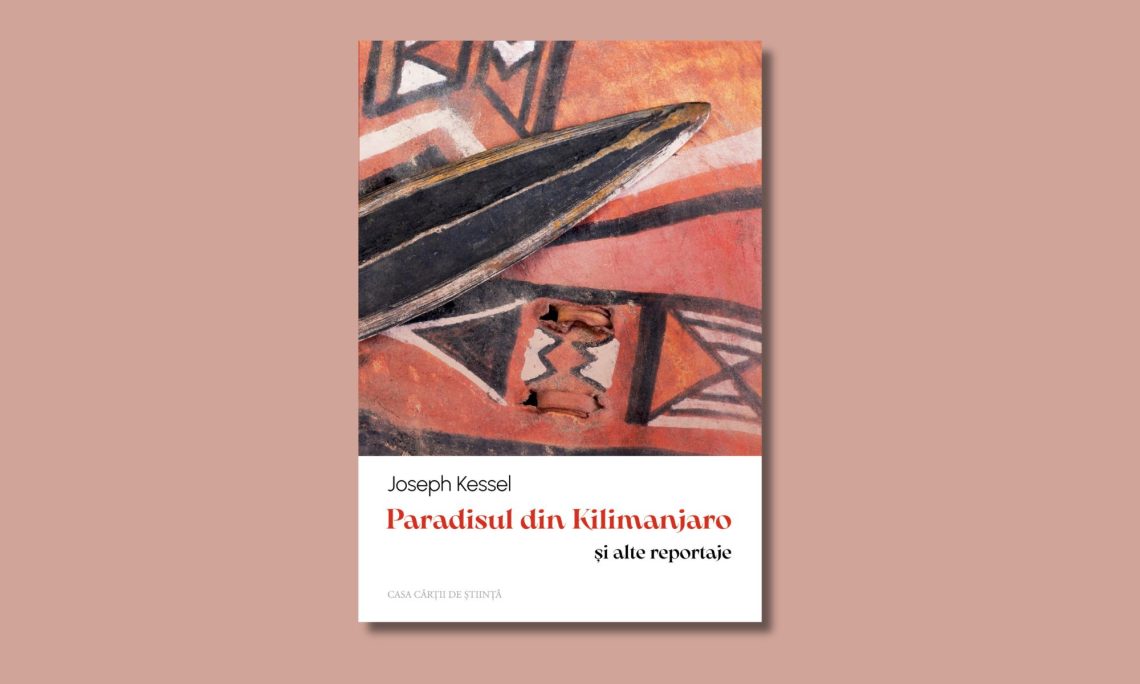

When one thinks of Kilimanjaro, what undoubtedly springs to mind is Hemingway’s short-story “The Snows of Kilimanjaro” (and quite possibly its cinematic adaptation in 1952, with Gregory Peck, Ava Gardner and Susan Hayward in the leading roles). But, albeit he is barely acknowledged by most contemporary readers, the French writer Joseph Kessel harboured, in his turn, a huge fascination (and admiration) for the African Continent, for its landscapes and people, all too obvious in his volumes of press-stories, particularly Le paradis du Kilimandjaro et autres reportages (“The Paradise of Kilimanjaro”) and Le lion (The Lion), which he published in the mid-1950s, subsequent to his travels out of Europe.
Always drawn to details that most Western readers would have easily missed out on, concerned not only with the singular beauty of this human and natural universe but also with the unbeknown dramas occurring in it – which he masterly captured in short, yet highly evocative texts – Joseph Kessel (1898-1979) was sometimes regarded as a representative of the ethno-literature of the second half of the twentieth century. However, aside from the details pertaining strictly to ethnography or local colour (or to the exoticism that many readers expected to find in texts inspired by the African space and culture), this writer had an innate grasp of the importance of playing up an elementary world, one fit to offer the most rewarding initiatory experiences to anyone capable of understanding and of keeping its secrets. From this vantage point, his travels to Africa emerge as genuine pilgrimages meant to unravel (to him and to his readers alike) not simply places or things that were somehow uncharted on the expanse of a vast continent, but mostly a pathway towards the comprehension of the world in which he lived and, more importantly, as he himself confessed, the pathway towards his inner self. Audacious, restless, intense, eager for knowledge, Kessel proved to be exactly as François Mauriac described him: “one of those people who will have been condoned any excess and who will have conquered the world without having relinquished their souls…”
Born in Villa Clara, Argentina, where his father, a physician of Jewish-Lithuanian descent, had settled after he had defended his doctoral dissertation in Montpellier, Joseph and his family made it to Orenburg (his mother’s birth-place), in Russia; and he would stay in love with the smell of the steppe and with the scent of wormwood forever. A few years later, the entire family settled in France. After he studied in Nice and Paris, equally conversant with the French and Russian cultures, with an all-round education at quite an early age, flabbergasting (and captivating) his school-mates, lured by the world of theatre, he nevertheless obtained employment as a journalist with “Journal des débats” and afterwards enrolled voluntarily in the Army, fighting in World War I as an artillerist and aviator. In 1928 he helped set up the weekly newspaper “Gringoire”, which he left, however, upon Hitler’s ascent to power and the onset of the persecution of the Jews in Germany, when the periodical adopted a blatantly anti-Semitic stance. During World War II he fought in the French Resistance, at first back on the battlefront as an aviator and afterwards as aide to Charles de Gaulle in London, where he and Maurice Druon composed the lyrics of the famous Song of the French Resistance, “Le Chant des Partisans”. Feeling, in his early twenties, as if he had already lived several lives, Kessel simply soared along the pathways of existence and of literature alike, trying, more often than not, to overcome by writing the problems and challenges with which not only great history but also his personal history confronted him: his brother committed suicide, his marital problems increased, and, according to his own words, he literally lived up to the hilt, “stranger to no excess” – from the glitzy parties of the ‘Roaring Twenties’ to the social and political upheavals in the aftermath of World War II.
A successful, prolific writer (he published no less than four books in 1932!), a reputed reporter and a journalist for decades on end, Joseph Kessel travelled along and across the world, publishing a plethora of feature reports, with his travels and war experience mirrored, by and large, by his entire literary work. Admired by his contemporaries and rewarded with prestigious prizes, Kessel published eighty novels, of which many were translated into foreign languages and were adapted to the screen on all continents, notably “L’Équipage” (1923, rewarded with the Prix Paul Flat by the French Academy), “Les Captifs” (1926, for which he received the Grand Prix du Roman de l’Académie française), “L’Armée des ombres” (1943), “Les Cavaliers” (1967). In 1962 he was elected Member of the French Academy and he also received important awards of distinction, such as the title of Grand Officer of the Legion of Honour, and in 2020 Éditions Gallimard awarded him a central place among the canonical French writers, undertaking the publication of his entire work in the prestigious “Bibliothèque de la Pléiade.”
Well-acquainted with both the political and the artistic world, showing a keen interest in the crucial moments of the time – which he unfailingly apperceived -, Kessel became famous for his succinct and utterly poignant depictions of certain realities or events that impacted on the entire twentieth century, such as the people who were part of the French Resistance – the embodiment of “a miraculous army of love and unhappiness, alongside which I realized that we were the shadows of shadows and the image of love and unhappiness…” It was probably precisely for that reason that, after the end of the War, he was drawn to countries that he considered “barefaced”, such as the African states of the 1950s, the Afghanistan of the 1960s, Ireland, Hong-Kong and Macao, across which he travelled, catching a glimpse of their underlying reality and unfailingly sensing precisely what made those places truly unique. Compared at times with Cendrars or Malraux, Kessel assessed, by means of these genuinely literary reports, the balance of forces between the East and the West, juxtaposing the rationalism of the West and the mysticism of the East, but he unwaveringly tackled certain sensitive or outright thorny issues as well, be they the trade relations between Asia and Europe or the different systems of values that had dominated these cultural spaces over the centuries.
All these are accurately rendered in the volume of press-stories recently published by Casa Cărţii de Ştiinţă Publishing House in Cluj-Napoca, in the exquisitely translated version signed by Rodica Baconsky and Alina Pelea – a volume that includes four of Kessel’s outstanding texts: ‘The Pygmy Clearing’, ‘The Last Gods of the Nile’, ‘Three Masai on the Plain’ and ‘The Paradise of Kilimanjaro’. Kessel writes with pathos and describes things with a rare talent; under his pen details become photographic-pictorial and the readers can literally visualise (before actually watching the televised reports and documentaries) the images that impressed the writer and which thus become truly unforgettable. Miniature descriptive gems, these texts reveal to Western readers a world that is utterly miraculous in its ancestral greatness and simplicity: “It took me a long time to take in what lay in front of my eyes. Huge herds, the frieze on the riverbank against the outback, under the last glorious glimpses of the waning Sun…Tall like rocks, their ears – huge fans, their trunks swinging, their column-like giant feet waddling, a hallucinating procession of force and serenity, uttermost forms of pre-history, the wild elephants came to drink water from the Nile. Behind them, in slow motion, white egrets, above them, spread out against the sky, long, fine, slender ibises, pink flamingos and shoe-billed storks flew in the air, returning to their secluded nests. Nightfall came, but the sky did not grow dark. It was full-moon time. Nowhere, ever before had I seen a Moon so round, so big or so bright.”
Kessel’s press-stories are a genuinely symbolic map of his far and wide travelling, of his journey towards the discovery of Africa (or of other lands and continents), but also of his quest for self-discovery. Therefore, providing an overall, exhaustive presentation of Kessel’s life and work becomes extremely challenging, for the mere reason that his passions were umpteen and his undertakings over the course of years were dizzyingly variegated. He was always keen on seeing everything, to then report everything. And every now and then, one finds it difficult to discern, in his literary work or in his pieces of journalism, what is reality and what (or how much) is pure fiction, as he oftentimes delivered raw narrative material, providing facts, events, figures and citing numerous sources. One cannot claim that Kessel was a great conscience of his time, like Zola, for instance, because he opted for journalism and for the press-story but – a noteworthy detail – he made that choice precisely in the heyday of that profession. His declared purpose was always to light upon and to sense the unique flavour of the moment, to depict, for his readers, humanity at its noblest (the Irish War of Independence, the activity of the Air Post) or its vilest moments (slavery in Abyssinia). For, after all, this is the key word that defines Kessel: humanity. Not incidentally, one of his closest contemporaries claimed that he somehow resembled Diogenes, who used to walk with his lit lantern in broad daylight, in the middle of the crowd, in quest of ‘an honest man’… And this is the truth indeed, as long as, when humaneness becomes manifest in people who pursue their dreams and ideals even amidst a cynical society, readers feel that Kessel’s style is blooming. And if the writer is not as popular as his biographers and admirers think that he should be, this is (partially) to blame on Kessel himself because, although he was outstandingly mature from an artistic point of view in The Red Steppe, the novel that he wrote when he was barely twenty-three, he oftentimes also chose to write and publish for money, as he himself confessed before he became a Member of the French Academy. So that, indeed, he did not manage to reshape French literature – as he claimed that he had wanted to do – but he nevertheless revived it, instilling in it that singular force which it had perhaps lacked more than once, as well as a narrative quality the charm of which may rightfully be called unique.
Joseph Kessel was an ardent writer who stood out among his fellow-writers also because, deep down, he had always been lured by the glitter and fervour (at times by the passion…) of life. He was, as other critics characterized him in the 1960s and 1970s, a writer with the soul of a great Russian novelist, writing with the finest French touch. In actual fact, Paul Valéry had noticed precisely this, right after the publication of The Red Steppe. “In these pages there is a huge percentage of pure terror and anguish, combined with the impressive force of a truth that is up-to-date and that has been exposed with amazing lucidity. All these against the background of the combined qualities of the two cultures and literatures – French and Russian -, both of which one must be perfectly familiar with in order to be able to approach such topics and to create such characters.” Because neither was Kessel the kind of writer drawn to psychology, like Stendhal, nor did he ever try, in Balzac’s manner, to compete with the Registry Office of the time. He was, first and foremost, a great story-teller, but one capable of speaking in multiple voices and of assuming just as many faces in order to leisurely unravel his manifold artistic facets, a creator who always knew how to depict a complex humankind, without, however, revealing it solely in its heroic or praiseworthy aspects.
Translated into English by Mirela PETRAȘCU
Joseph Kessel, „Le paradis du Kilimandjaro et autres reportages” (“The Paradise of Kilimanjaro”)/ „Paradisul din Kilimanjaro şi alte reportaje”, translated into Romanian by Rodica Baconsky and Alina Pelea, Casa Cărţii de Ştiinţă, Cluj-Napoca, 2024
Sumar Literomania nr. 403 (2026)


Scrie un comentariu