


„Pebbles on the riverbed
wavering: clear water.”
(Natsume Soseki)
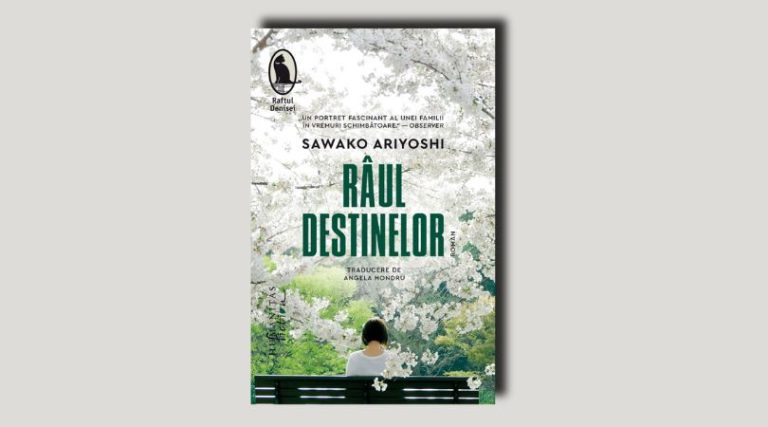
Sawako Ariyoshi’s novel „The River Ki” begins precisely when the nineteenth century is about to end. And the first pages of the book are thoroughly illustrative of what follows, as they describe two female characters who will define a large part of the novel and who will trigger, albeit indirectly, the crucial events that will occur in their families. Thus, Grandmother Toyono Kimoto is making preparations for the ceremony of her granddaughter Hana’s marriage to Keisaku. And before the time comes for the young woman, barely in her twenties, to leave for her new home with the Matani family, down the River Ki in the Kansai region, the two – grandmother and granddaughter – go to the temple to spend a few moments together. Not necessarily because Toyono, the one who has stood in for her mother, would have anything special to tell her granddaughter but because, albeit wary of showing it, she would like to postpone the moment, even if only for the short while necessary for a visit of recollection to the temple.

In a way, the first pages of „The River Ki”, the novel published in 1959, set the tone for the entire novel and highlight the importance of the feminine characters to this text, as well as to the entire work of Sawako Ariyoshi, who has been regarded as one of the most important voices of twentieth-century Japanese fiction and even (according to certain exegetes) as a genuine Simone de Beauvoir of Japan. A special mention should be made about the Romanian version of this book (recently published by Humanitas Fiction in „Raftul Denisei” Collection), signed by Angela Hondru, the outstanding translator of Japanese fiction who, over the years, has offered Romanian readers a plethora of translations of fiction works published in the Archipelago, from „The Tale of Genji” (transl. „Povestea lui Genji”) to the great fiction works of Yasushi Inoue, Yukio Mishima, Haruki Murakami or Fumiko Enchi, to mention these names alone.
The River Ki, with a rather short course, yet majestic at every turn on its seawards journey south of Osaka, crosses precisely those regions that have been intertwined, over the centuries, with the very essence of the Japanese tradition. And in crossing this region, it traverses mountains and rivers, it nourishes rice fields and it is the witness of the plights and joys of the people living on its banks. Powerful enough to threaten, when its waters swell, everything that might stand in its path, but equally gentle and placid, when the weather is light and clear, to carry the imposing nuptial procession sailing boats, the River Ki sways, in its own way, over the lives of the people nearby. But it is also this river that bestows upon those living at its banks a distinctive force – especially on the women in Ariyoshi’s novel, so close, symbolically speaking, to this watercourse. And this is apparent from the very beginning, ever since the moments preceding beautiful Hana’s wedding.
The young bride is about to travel down the river in an impressive, elegant procession, to her new family’s home. Apparently a delicate, demure girl, ready to pay heed to the Matani family, Hana will actually turn out to be, just like the River Ki, a presence only outwardly quiet but in real fact an indomitable force that will profoundly impinge upon the lives of those around her – and this will prove true both in the case of her husband and of those in the future generations of her family. A family that will be traced in its female lineage, which stands proof to the author’s lasting conviction that, irrespective of how important men’s choices or actions may seem (or may even be, at times…), they are always triggered by those women who, even without being seen or (re)cognized by the others, are the ones who decide what in actual fact matters. And this stands true especially in the case of Hana, the one who gives the impression that she will integrate rapidly and perfectly into her husband’s family, accepting without question her mother-in-law’s authority and her brother-in-law’s frequent mood swings (or his more or less blatant antagonism of her…). However, underneath the appearances there is an unflinching woman who will prompt her husband to make all the right choices, push his political career and who will turn out to be the pivotal person in the household. Certainly, none of these happen overnight but will take long years of patience, as the shift in the hierarchy of power will have become obvious only after the birth of her son and mainly after that of her daughter, Fumio.
And if the first part of the novel is centred on Hana, the protagonist of the second part will be Fumio, while the third (and last) part will revolve around Hanako, Fumio’s daughter. „The River Ki” depicts the lives of these three women in the Matani family from the beginning of the twentieth century until the aftermath of World War II. An age of profound transformations, political, economic and social alike, the first decades of the twentieth century were the capstone of Japan’s modernization process (advanced at the beginning of the Meiji Period, in 1868 – the start of the Meiji Restoration Era), which occurred rapidly, by skipping stages fast – aspects whereof were tackled in all the great novels of Japanese writers such as Yasunari Kawabata, Yukio Mishima and Osamu Dazai. Sawako Ariyoshi wrote along the same lines, but she stands out by the feminine perspective she took on, which is to be found in her most accomplished novels, such as „The Doctor’s Wife” and „Kabuki Dancer”, but which is perhaps best highlighted precisely in „The River Ki”. Because here, in the Matani family, the readers will better grasp, by means of these female characters (mother, daughter and granddaughter), all the intricacies and tensions engendered by the rapid forsaking, in Japan, of some of the traditional customs in favour of a Western lifestyle. Proof to this stands the attitude of Fumio, who wants to emancipate herself, regarding as obsolete the old customs and rules of behaviour, and who blatantly rejects most of her mother’s life choices. Resolute, always active and at times maybe too energetic for her family (but also for the Japan of those times…), Fumio, the self-declared feminist of her kin wants to study, to leave her home, to live differently and to be free to make her own choices, determined to break with everything that involves tradition and out of step with the boring existence of her mother, with whom she more than once conflicts. But ironically (though by no means paradoxically…), it is the representative of the next generation, namely Fumio’s own daughter, Hanako, who will turn out to be interested in the Japanese traditional way of life and will become close precisely to her grandmother Hana.
An outstanding family novel, singular in the Japanese fiction of the time due to its feminine perspective, „The River Ki” is at the same time a remarkable social fresco of the first half of the twentieth century in the Archipelago. The years pass, like the flow of the River Ki, the one that constantly accompanies the lives and the great decisions of all the novel’s characters, and with them Japan sheers from its rigid rules of behaviour and strict ceremonials to a way of life consonant with the rhythms and values of the Western world, especially in the years ensuing World War II. Against this backdrop, Japanese politics undergoes a transformation, from the great confrontation with Russia, which had marked the beginning of the century, to the threat of radicalism and that of the World conflagration, both of which will leave their indelible mark on the country and on the world at large. But Ariyoshi’s interest lies less with the great historical events and more with their imprint on the lives of the Matani women, forced to adapt, to accept changes (even when they claim that they obstinately refuse change…) and to live their lives at their own pace, like the River Ki, which seems to guide their steps on a symbolical level.
In fact, the novel can – and should – be interpreted on a symbolical level as well, since the importance of the connection with the River Ki has been emphasized from the very beginning, by way of Grandmother Toyono’s narrative voice. Because, even if she had received several other marriage proposals for her granddaughter (some of which were even better!), the grandmother decided that the young woman should choose young Matani, because, in order to arrive at his house (her future home), Hana would have to travel down the river, not upstream, where the house of her other suitor was: „The River Ki flows from the East westwards. […] The future brides living on the banks of the River Ki are not allowed to move upstream”. Moreover, even if the men’s actions sometimes seem to matter, as they are the ones who leave home in their attempt to assert themselves in politics or in business, the women are nevertheless the ones who really make a difference, as it is only they who inspire, influence and sometimes even give an impetus to their husbands or children to do certain things (while tactfully giving them the impression that they have acted on their own initiative!). And, even if at first value Hana and Fumio seem to be like night and day, they are tantamount in their drive and efforts to help their husbands become successful. At the opposite end is Hana’s eldest son, Seichiro, who has settled for a comfortable, plentiful life, but who totally lacks the ambition that drives his mother and his sister… Precisely for this reason, the novel’s strong point is the emphasis on the timeless, profound connections, be they complicated, between the female characters, between mother and daughter, grandmother and granddaughter – depicted with an amazing passion for detail and commensurate with the continuous flow of the River Ki, a genuine river of destinies and of the very destiny of Japan itself.
Somehow, this river is the everlasting constant in a human universe subject to changes of all kinds and it mirrors all the fears and hopes of the Matani women, whose lives flow alongside it. The book thus becomes a remarkable novel of atmosphere as well, singular in the context of both twentieth-century Japanese feminine fiction and of Ariyoshi’s work. And the River Ki becomes, in its turn, the silent witness of all the great historical events and of the events in the lives of these three women, as well as the very element that imparts on them the courage to get through the dire situations they are confronted with – the courage to wade across life alongside them, not against destiny or against the water flow, but forever sideways…
Sawako Ariyoshi, „The River Ki”/ „Râul destinelor”, translation into Romanian and notes by Angela Hondru, Humanitas Fiction Publishing House, Bucharest, 2024
Translated into English by Mirela Petraşcu
Sumar Literomania nr. 393 (2026)

Monolog marțian (II) (fragment din romanul „Îngeri și marțieni”)

„Gamela (toamnă)” de Italo Calvino
The Tideway of Destiny

Radu Țuculescu – un virtuoz al genului scurt

Călătorie în Est

„Chifteluța” de Dino Buzzati

Lumea lui Tadej Golob
„Ospățul Împăratului” de Dino Buzzati

Ștefan Baciu – poetul nostalgiei, poetul libertății (II)

„O șopârliță” de Juan Burghi
Fawzia Zouari. Stories and Secrets
Poeme de Georg Trakl în traducerea lui Ștefan Baciu
„Oameni care vor fi mereu cu mine” (fragment) de Narine Abgarian
Poeme de Ana Patricia Collazos

„Există un om care obișnuiește să-mi dea cu o umbrelă în cap” de Fernando Sorrentino

„Călăul” de Silvina Ocampo






Scrie un comentariu